




- Lens Surgery

Implantable Contact Lens (ICL)


- Treatment
- Lens Surgery
Implantable Contact Lens (ICL)
When people consider the possibility of life without traditional contact lenses or glasses, often they’re thinking of LASIK or another type of laser eye surgery, but that’s not the only option
The ICL offers exceptional vision by placing a tiny biocompatible lens, much like a traditional contact lens, inside your eye, for long term crisp, clear vision, without the hassles of having to replace or clean them each day and without using any lasers or altering the natural structure of your eye.
It’s a quick, safe and reversible procedure. Giving you excellent vision and all future options available as your eyes age.
What is an Implantable Contact Lens
ICL (Implantable Collamer Lens) have over 30 years of outcome and safety results and, to date, over 4,000,000 ICLs have been implanted worldwide for improved vision. Custom made for each individual, the lens is a micro-thin implant that is able to correct a wide range of refractive errors, even very high prescriptions, from -0.5 D up to -20 D short-sightedness (patients aged 21-60), +0.5D up to +16.00D longsightedness (patients aged 21-45) to, whilst also correcting up to 6 D of astigmatism.

EVO ICLTM is made from a technologically advanced collagen based Collamer® material, the Implantable Collamer Lens is designed to be inert and compatible with the natural environment of the eye. Other advantages of Collamer include UV protection – both UV-A and UV-B protection – anti-reflectivity and exceptional optical clarity.
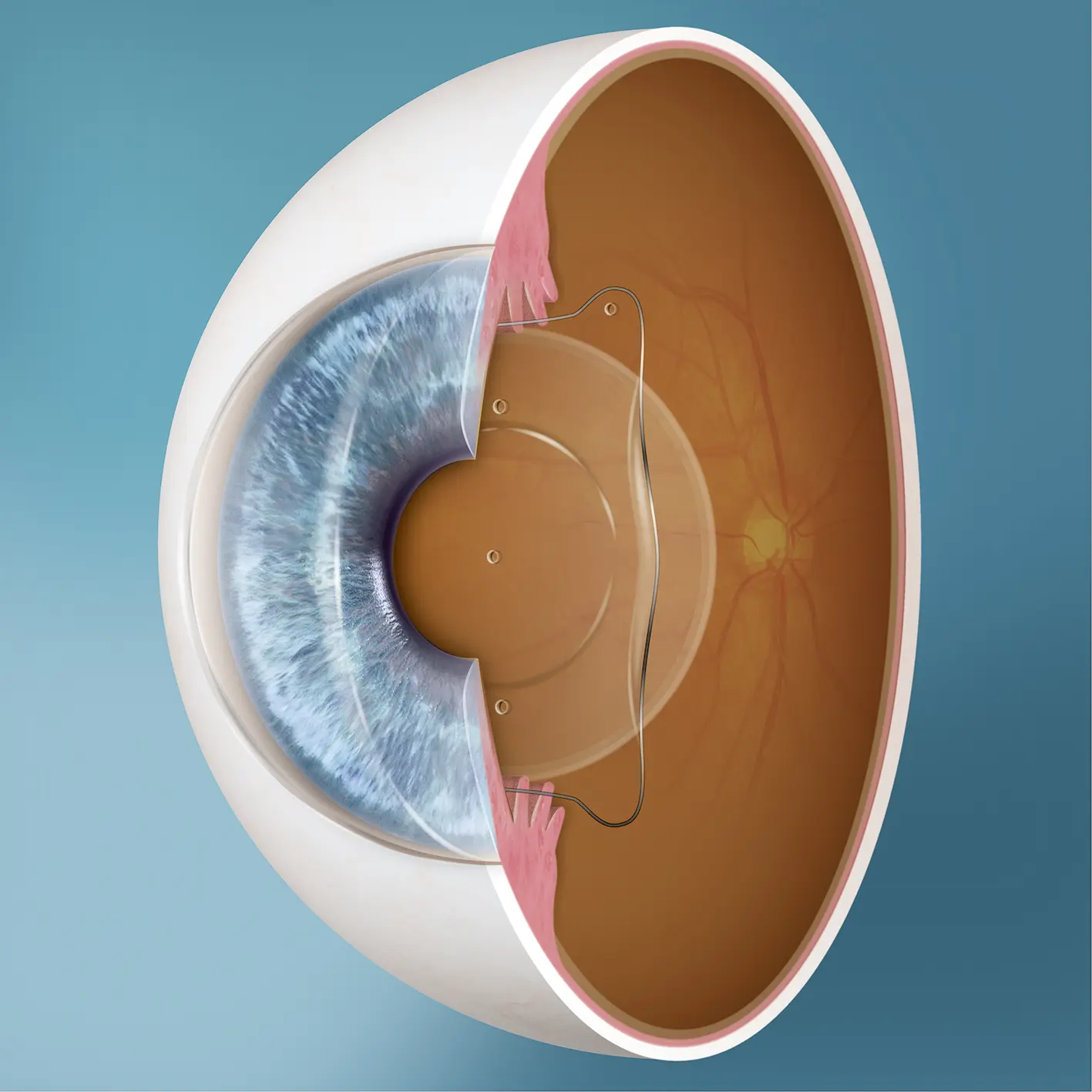
The EVO ICL is implanted through a tiny self-healing port and the soft lens sits above the natural crystalline lens of the eye, being positioned behind the iris (coloured part of the eye) and in front of the natural lens. Once implanted, the flexible lens is invisible to the naked eye, unlike traditional contact lenses and cannot be felt within the eye.
The EVO ICL procedure takes less than 15 minutes to perform and is often performed under local anaesthetic, meaning patients are able to walk out of the surgical theatre once finished. For patients who are anxious, general anaesthesia or sedation can be administered. The ICL is a reversible procedure meaning that in the future, the lens can be removed should the need arise for any reason, leaving all future options and technologies available.
EVO ICLTM is made from a technologically advanced collagen based Collamer® material, the Implantable Collamer Lens is designed to be inert and compatible with the natural environment of the eye. Other advantages of Collamer include UV protection – both UV-A and UV-B protection – anti-reflectivity and exceptional optical clarity.
The EVO ICL is implanted through a tiny self-healing port and the soft lens sits above the natural crystalline lens of the eye, being positioned behind the iris (coloured part of the eye) and in front of the natural lens. Once implanted, the flexible lens is invisible to the naked eye, unlike traditional contact lenses and cannot be felt within the eye.
The EVO ICL procedure takes less than 15 minutes to perform and is often performed under local anaesthetic, meaning patients are able to walk out of the surgical theatre once finished. For patients who are anxious, general anaesthesia or sedation can be administered. The ICL is a reversible procedure meaning that in the future, the lens can be removed should the need arise for any reason, leaving all future options and technologies available.


Implantable Collamer Lens Surgery Procedure
- 1.Local anaesthetic eye drops are applied to both eyes
- 2.The area around your eye will be cleaned and a drape applied.
- 3.To prepare for the implant your doctor will create one small opening at the base of your cornea to insert the EVO ICL lens. The procedure is painless because of the numbing medication.
- 4.An ICL is gently inserted through a tiny incision in the cornea, and the lens is positioned behind the iris and floated on the natural lens
- 5.The EVO ICL lens then can be folded and inserted through the small incision your doctor has made. Once the lens is inserted the doctor will make any necessary adjustments to ensure proper positioning in the eye
- 6.At this point, the procedure is over and many patients will have improved vision nearly immediately. Your doctor will prescribe more eye drops intended to aid in the healing process following the procedure. You will need someone to drive you home. Your doctor will tell you when your vision allows driving.